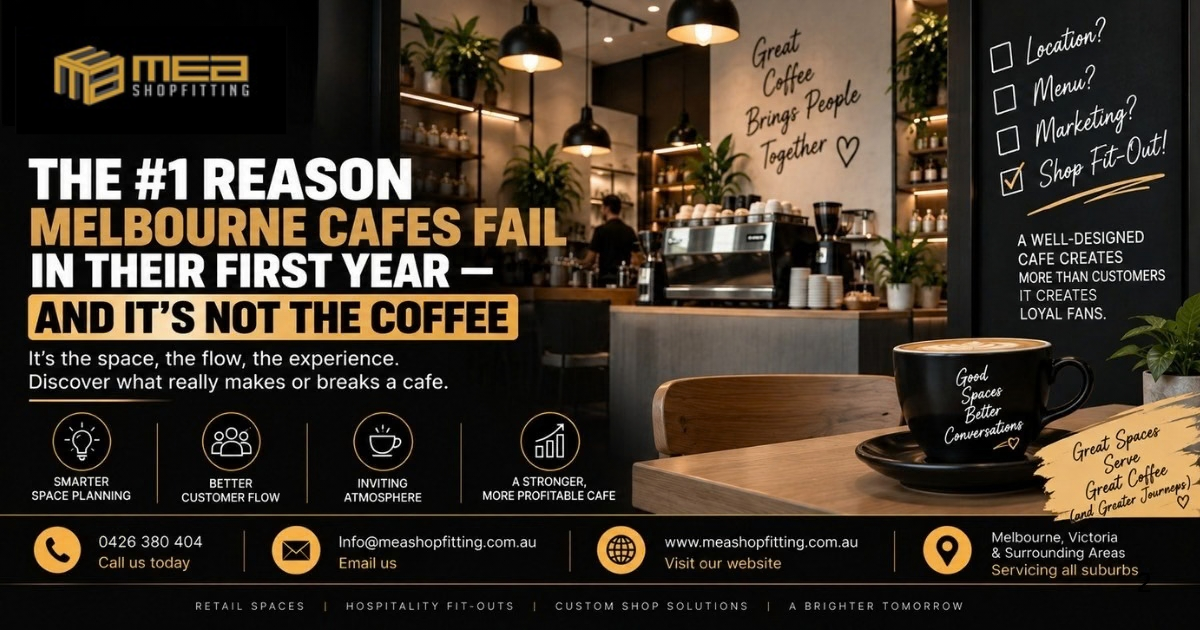
Walk down any strip in Melbourne — Chapel Street, Sydney Road, Bridge Road, or the main drag of a regional town like Bendigo or Ballarat — and you’ll notice the same thing. New cafes pop up full of excitement, fresh signage, a proud opening week, and a queue out the door. Then, twelve months later, the shutters are down and a “For Lease” sign is back in the window.
If you ask most people why a cafe closes, they’ll say the coffee wasn’t good enough, or the prices were too high, or a bigger chain moved in nearby. We hear this all the time from clients who come to us after a first attempt didn’t work out, and honestly, it’s rarely about the coffee at all.
At MEA Shopfitting, we’ve fitted out cafes, restaurants, retail stores and hospitality venues right across Melbourne and regional Victoria for years now, and the pattern is almost always the same. The coffee was fine. The staff were friendly. The menu was solid. What let the business down was the space itself — the layout, the flow, the atmosphere, and how the whole fit-out worked (or didn’t work) for the way customers actually move through a cafe In Melbourne cafes fail.
It’s Not the Coffee — It’s the Space For Melbourne cafes fail
Melbourne is arguably the coffee capital of Australia. There is no shortage of good baristas, quality beans, or people who genuinely know how to pull a proper espresso. So when a cafe with decent coffee still struggles to survive its first year, something else is going on.
More often than not, it comes down to a handful of very physical, very fixable problems:
- Customers can’t tell where to queue, order, or sit when they walk in
- The kitchen and coffee station aren’t positioned for a fast, smooth service flow
- Seating is either too cramped to be comfortable or too spread out to feel full and lively
- Lighting is either too harsh (feels clinical) or too dim (feels like it’s closing down)
- There’s no real “moment” in the space that makes someone want to take a photo and tag the cafe
- The counter and till area create bottlenecks during the morning rush
None of these are coffee problems. They’re shopfitting problems. And they’re the kind of thing a business owner often can’t see clearly themselves, because they’re too close to the project and too focused on the menu, the branding, and the opening date.
Why the Space Matters More Than People Think
A cafe isn’t just somewhere people buy a flat white. It’s a space people choose to spend time in — sometimes for ten minutes, sometimes for two hours with a laptop. The layout, the flow, and the overall feel of the venue decide whether customers stay, come back, and bring their friends, or whether they grab a takeaway coffee once and never return.
Good spaces create better conversations, and better conversations create loyal customers. That’s the whole idea behind a well-planned fit-out — it’s not about making a cafe “look nice” for the sake of it, it’s about designing a space that actually works for the people running it and the people visiting it.
A well thought out cafe fit-out gets a few key things right:
Smarter space planning. Every square metre of a cafe costs rent, so wasted space is wasted money. A properly planned layout makes sure the kitchen, counter, seating and storage all work together instead of competing with each other.
Better customer flow. People should be able to walk in, know exactly where to order, find a seat, and get in and out during a lunch rush without bumping into three other customers along the way.
An inviting atmosphere. Lighting, materials, furniture and finishes all combine to create a feeling — and that feeling is what brings people back on a rainy Tuesday even when there are five other cafes on the same street.
A more profitable business. At the end of the day, a fit-out isn’t just about aesthetics. Every design decision, from where the till sits to how many covers you can fit, has a direct impact on turnover and profit margin.
What This Looks Like in Melbourne’s Cafe Scene
Melbourne’s cafe culture is famously competitive, and that competition has only grown over the last few years. New cafes open in the CBD laneways, in suburban strip shopping centres, and in growth corridor suburbs almost every month. Standing out isn’t just about a good Instagram photo on opening day — it’s about building a venue that holds up under six-day trading, back-to-back rushes, and years of daily wear and tear.
The businesses that last tend to have one thing in common: they invested properly in their fit-out from day one, rather than trying to patch together a space on a shoestring budget and fix it later. By the time an owner realises the layout isn’t working, they’ve usually already lost months of trade and a chunk of their reputation with local customers.
This is where a specialist commercial fit-out company makes the difference. It’s not just about carpentry and coffee machines — it’s about understanding hospitality operations, council and health regulations, kitchen exhaust and grease trap requirements, accessibility standards, and how real customers behave in a real space during a real morning rush.
MEA Shopfitting: Commercial Fit-Outs Across Melbourne and Regional Victoria
At MEA Shopfitting, we specialise in retail and hospitality fit-outs, working with cafe owners, restaurateurs and retailers across Melbourne, Victoria and surrounding regional areas. Whether you’re opening your very first cafe or refreshing a venue that’s lost its spark, we handle the fit-out from concept through to completion — shopfront design, joinery, counters, kitchen layout, lighting, seating, and finishing touches.
We work with clients throughout Melbourne’s suburbs as well as regional centres including Bendigo, Geelong, Somerville, Moe, Officer, Melton, and Seymour, along with the towns and communities in between. Wherever your site is, our approach is the same: understand how your business actually operates day to day, then build a space around that reality — not the other way around.
Our focus areas include:
- Cafe and restaurant fit-outs
- Retail space fit-outs
- Custom joinery, counters and shopfronts
- Commercial kitchen layout and installation
- Full hospitality refurbishments and renovations
We know that every suburb and town has its own character, its own foot traffic patterns, and its own customer expectations. A cafe fit-out that works on a busy Melbourne CBD laneway won’t necessarily suit a family-friendly strip in Officer or a heritage main street in Ballarat. That’s why we take the time to understand the local context before a single wall goes up.
Getting It Right the First Time
Redoing a fit-out after a failed first attempt is expensive, disruptive, and often avoidable. It usually means closing for weeks, absorbing lost trade, and starting the branding conversation all over again with customers who are already forming their opinion of your business.
The smarter move is to get the fundamentals right before opening day — proper space planning, sensible customer flow, a layout that supports your staff instead of working against them, and a look and feel that matches what your brand is trying to say. Great coffee will always matter. But it’s the space around that coffee cup that decides whether someone becomes a regular or a one-time visitor.
If you’re planning a new cafe, restaurant or retail space anywhere across Melbourne, Bendigo, Ballarat, Geelong, Somerville, Moe, Officer, Melton, Seymour or the surrounding suburbs, it’s worth having a conversation about your fit-out before you sign a lease or finalise a floor plan. A short chat early on can save months of trial and error later.
Frequently Asked Questions About Melbourne cafes fail
1. What is the biggest reason cafes fail in their first year in Melbourne? While people often blame the coffee or the menu, the real issue is usually the physical space — poor layout, awkward customer flow, an uncomfortable atmosphere, or a kitchen and counter set-up that slows down service. These are all things that come down to the initial shopfitting and design decisions.
2. Does MEA Shopfitting only work in Melbourne, or do you cover regional Victoria as well? We service Melbourne and its surrounding suburbs, as well as regional areas including Bendigo, Ballarat, Geelong, Somerville, Moe, Officer, Melton, Seymour and nearby towns. If you’re unsure whether your location is within our service area, give us a call and we’ll happily let you know.
3. How early should I involve a shopfitting company when opening a cafe? As early as possible — ideally before you sign a lease. A shopfitter can help you assess whether a site actually suits your concept, spot potential issues with kitchen placement or council requirements, and give you a realistic idea of layout, cost and timeframe before you’re locked into a commitment.
4. Can MEA Shopfitting help refresh an existing cafe rather than starting from scratch? Yes. A lot of our work involves refurbishing existing cafes and retail spaces that have lost customer interest or simply aren’t working operationally anymore. Sometimes a few targeted changes to layout, counter positioning or lighting can make a significant difference without a full rebuild.
5. What does a typical cafe fit-out with MEA Shopfitting include? It depends on the scope of your project, but our cafe and hospitality fit-outs generally cover space planning, custom joinery and counters, shopfront design, kitchen layout, lighting, seating design and finishing touches — everything needed to take a space from an empty shell to a working, welcoming cafe.
Get in Touch
If you’re planning a cafe, restaurant or retail fit-out anywhere across Melbourne, Victoria and surrounding suburbs, the team at MEA Shopfitting is here to help you get it right from the start.
Phone: 0426 380 404 Email: Info@meashopfitting.com.au Website: www.meashopfitting.com.au Servicing: Melbourne, Victoria and surrounding suburbs