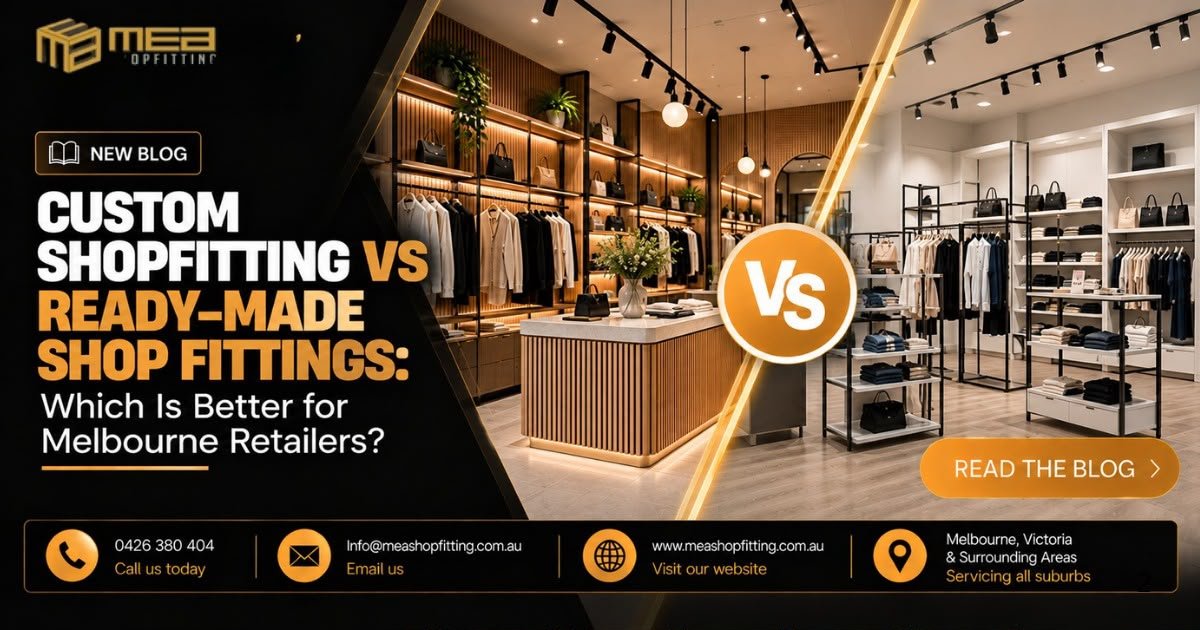
Choosing between custom shopfitting and ready-made shop fittings is an important decision for any retailer planning a new store, renovating an existing shop, or expanding their business. The right choice can influence how your products are displayed, how customers move through your store, how efficiently your staff work, and how well your retail environment represents your brand.
For business owners across Melbourne, Victoria, the decision is not always as simple as choosing the cheapest option. Ready-made shop fittings can offer convenience and faster installation, while custom shopfitting provides greater flexibility for businesses that need a distinctive design, specific dimensions, or a more personalised shopping environment.
At MEA Shopfitting, we understand that every commercial space has different requirements. A small fashion boutique, a beauty store, an electronics retailer, and a large showroom will not necessarily benefit from the same layout or display solutions. The most suitable approach depends on the available space, products, budget, business goals, and the experience you want to create for your customers.
As a commercial fit-out and shopfitting company serving Melbourne and surrounding Victorian areas, MEA Shopfitting helps businesses plan practical, professional spaces that balance appearance with everyday functionality.
In this guide, we explore the differences between custom shopfitting and ready-made shop fittings, their advantages and limitations, and how Melbourne retailers can decide which option best suits their business.
What Is Custom Shopfitting?
Custom shopfitting involves designing and creating retail fixtures, displays, counters, shelving, storage units, and other interior elements specifically for a particular business and its premises. Rather than selecting everything from standard sizes and designs, retailers can develop a shop layout that reflects their brand identity, product requirements, and available floor space.
For example, a fashion boutique may need carefully designed clothing displays, fitting-room storage, a feature wall, and a checkout counter that complements its interior design. A cosmetics retailer may require specialised shelving, illuminated product displays, mirrors, and organised storage for smaller products. A homewares showroom may need larger display areas and flexible arrangements for products of different sizes.
Custom shopfitting allows these requirements to be considered during the planning stage.
One of its main advantages is that fixtures can be designed around the actual dimensions of the premises. This can be particularly useful in Melbourne retail properties where unusual wall angles, narrow layouts, structural columns, limited storage, or existing building features create challenges.
Custom shopfitting can also help establish a consistent visual identity. Materials, colours, finishes, lighting, signage, and joinery can be selected to complement the business’s branding and the products it sells.
However, custom shopfitting generally requires more planning than purchasing standard fixtures. Measurements, design decisions, material selection, manufacturing, and installation all need to be coordinated. The final cost depends on the complexity of the design, materials, quantity of fixtures, and the wider commercial fit-out requirements.
For retailers who want a distinctive store that makes effective use of their space, custom shopfitting can be a worthwhile investment.
What Are Ready-Made Shop Fittings?
Ready-made shop fittings are standard retail fixtures manufactured in predetermined sizes, designs, and finishes. These products are usually available through retail fixture suppliers and can include shelving systems, display racks, clothing rails, counters, storage units, gondola shelving, and freestanding display stands.
They are commonly used by retailers who need a straightforward way to organise products without commissioning every fixture individually.
A small shop opening on a limited budget, for example, might use standard shelving along the walls, freestanding display racks in the centre, and a ready-made checkout counter near the entrance. This arrangement can be suitable when the available fixtures match the store dimensions and operational needs.
The main advantages of ready-made shop fittings are convenience, predictable product specifications, and potentially lower upfront fixture costs. Because the products are manufactured in standard sizes, retailers may be able to purchase and install them without waiting for custom manufacturing.
Ready-made fixtures can also be practical for temporary retail spaces, seasonal displays, pop-up shops, and businesses that expect to change their layouts regularly.
However, standard products are not designed specifically for every store. A shelf may not fit neatly into an awkward corner, a counter may occupy more floor space than expected, or a display unit may not provide the right dimensions for particular products.
Retailers should also consider the quality, durability, assembly requirements, delivery costs, and compatibility of the selected fittings before making a purchase.
Ready-made fixtures can be an excellent solution when they meet the needs of the business. The important point is to avoid choosing them purely because they appear cheaper at the beginning.
Custom Shopfitting vs Ready-Made Shop Fittings: The Main Differences
The biggest difference between custom shopfitting and ready-made shop fittings is the degree of control you have over the final retail environment.
Custom shopfitting gives you more control over dimensions, finishes, storage, display arrangements, and the overall design. Ready-made shop fittings offer standardised solutions that can be simpler to purchase and install.
1. Cost and Budget
Budget is often the first concern for retailers planning a commercial fit-out in Melbourne. Opening a business involves many expenses, including rent, stock, signage, lighting, equipment, staffing, and marketing. It is understandable that business owners want to control their initial investment.
Ready-made shop fittings can reduce upfront fixture costs because standard products are manufactured in larger quantities. They may also require less design work, making them suitable for businesses that need a simple setup.
Custom shopfitting can involve additional design, manufacturing, material, and installation expenses. However, the final cost varies considerably depending on the project. A few custom counters or display units may be more practical than commissioning an entirely customised interior.
It is also important to compare the complete cost rather than looking only at the purchase price. Delivery, assembly, installation, alterations, replacement parts, and the amount of usable space created by the fixtures can all affect overall value.
For example, a retailer might purchase inexpensive shelving that leaves awkward gaps throughout the store. If those gaps reduce product display capacity or require additional furniture, the initial saving may be less valuable than expected.
The better approach is to establish a realistic budget and identify where customisation will make the greatest difference. A combination of custom joinery and standard shelving may provide the right balance between cost and functionality.
2. Design and Brand Identity
Customers experience a retail brand through more than its logo and advertising. The store environment also contributes to how the business is perceived.
A premium fashion boutique, for instance, may want carefully selected finishes, integrated lighting, elegant display units, and a reception counter that complements its brand. A sports retailer may prioritise strong shelving, clear product categories, and easy access to merchandise.
Custom shopfitting allows these design requirements to be incorporated into the physical space. Fixtures can be coordinated with the store’s colours, materials, signage, and overall visual direction.
Ready-made shop fittings provide fewer opportunities for individual design choices. Although standard fixtures can still create an attractive store, their appearance and dimensions may limit how closely the interior matches the intended brand image.
For retailers competing in busy shopping areas across Melbourne, a well-planned store design can help create a recognisable and consistent customer experience.
This does not mean every business needs expensive custom furniture. What matters is selecting fixtures that support the brand rather than making the store feel disconnected or poorly organised.
3. Space Utilisation and Store Layout
Retail floor space is valuable, particularly in smaller Melbourne shops where every square metre needs to serve a purpose.
The position and dimensions of shelving, counters, displays, and storage areas can influence how easily customers navigate the store. Poorly positioned fixtures may obstruct walkways, hide merchandise, create congestion, or leave useful areas underutilised.
Custom shopfitting allows fixtures to be planned around the actual premises. Built-in storage, corner shelving, wall-mounted displays, and appropriately sized counters can help make better use of the available space.
Ready-made shop fittings can also work well in compact stores, provided their dimensions suit the layout. Modular shelving and adjustable systems may offer flexibility without requiring a fully customised design.
Before selecting fixtures, retailers should consider where customers will enter, how they will move between product categories, where staff will work, and how stock will be stored. Access, circulation, and applicable building requirements should also be considered during planning.
For a small boutique in Melbourne, for example, a combination of wall-mounted displays, compact storage, and a carefully positioned checkout counter may create a more practical environment than filling the floor with oversized shelving units.
A good retail layout is not about fitting in the maximum number of fixtures. It is about making the space work for customers, employees, and the business.
4. Installation Time and Project Scheduling
The time required to fit out a retail store depends on the type of work involved, the condition of the premises, the availability of materials, and any approvals or building work that may be necessary.
Ready-made shop fittings can be quicker to obtain when the required products are in stock and suitable for the space. This makes them attractive for temporary stores, straightforward retail setups, or businesses working towards a tight opening date.
Custom shopfitting generally requires additional coordination because fixtures must be measured, designed, manufactured, and installed. The schedule will depend on the complexity of the work and the production lead times.
However, custom fixtures do not necessarily mean that the entire project will be delayed. Early planning, accurate measurements, timely design approvals, and coordinated installation can help keep the work organised.
Retailers should discuss the intended opening date with their shopfitter before finalising the design. They should also allow time for any required landlord approvals, shopping centre requirements, permits, inspections, and specialist trades.
Starting the planning process early can reduce the likelihood of last-minute changes and unnecessary disruption.
5. Quality, Durability, and Maintenance
The quality of shop fittings matters because retail fixtures are used every day. Shelving supports merchandise, counters are used by staff and customers, and display units may be moved or cleaned frequently.
Both custom and ready-made shop fittings can be durable. The difference depends on the materials, construction methods, hardware, finish quality, expected load, and suitability of the product for its intended use.
A busy grocery store may need robust shelving that can handle regular restocking. A beauty store may require easy-to-clean counters and carefully arranged product displays. A fashion retailer may prioritise clothing rails, shelving, and cabinetry that remain attractive under daily use.
With custom shopfitting, materials and construction details can be selected according to these requirements. Ready-made fittings can also provide reliable performance when purchased from a reputable supplier and chosen for the correct application.
When comparing options, ask about material specifications, load limits, cleaning requirements, warranties, replacement components, and the availability of repairs.
Choosing the cheapest fixture without considering how it will perform over time can lead to additional maintenance or replacement costs. Equally, premium custom fixtures are not automatically necessary for every area of a shop.
The aim should be to invest in quality where it matters most.
6. Flexibility for Future Changes
Retail businesses evolve. Product ranges change, seasonal promotions require different displays, and growing businesses may need more storage or additional merchandising space.
Ready-made modular fittings can be particularly useful when flexibility is a priority. Adjustable shelves, movable racks, and freestanding units may be rearranged without major construction work.
Custom shopfitting can also incorporate flexibility into the original design. Adjustable shelving, replaceable display panels, modular cabinetry, and adaptable storage can help the store respond to future changes.
The important distinction is between fixtures designed for a specific purpose and fixtures designed to accommodate changing needs.
A retailer planning to operate from the same premises for many years may benefit from custom elements that improve everyday functionality. A temporary business or pop-up store may prefer standard fixtures that can be reused at another location.
Think about how the business may change over the next few years before committing to a complete fit-out.
When Should Melbourne Retailers Choose Custom Shopfitting?
Custom shopfitting is particularly suitable when a store needs a distinctive appearance, has unusual dimensions, or requires fixtures that standard products cannot provide.
A boutique retailer may want custom display shelving and a feature counter that reflect its brand. An electronics store may require secure displays, integrated cable management, and specific storage arrangements. A cosmetics shop may need compact product displays, mirrors, specialist lighting, and organised back-of-house storage.
Custom shopfitting may also be worth considering when a store has limited floor space. Purpose-designed fixtures can be developed to suit the available layout rather than forcing the business to work around standard furniture dimensions.
Retailers undertaking a complete renovation may prefer a coordinated design in which joinery, counters, shelving, wall finishes, lighting, and other interior elements work together.
Another important consideration is the customer experience. If the business relies on premium presentation, product demonstrations, personalised service, or a carefully controlled brand environment, custom fixtures can help create the right setting.
However, custom shopfitting should be based on genuine business needs rather than appearance alone. Before proceeding, identify which features will improve the way the store operates and which are simply decorative additions.
This helps ensure that the investment supports the business instead of placing unnecessary pressure on the budget.
When Are Ready-Made Shop Fittings the Better Option?
Ready-made shop fittings are often a sensible choice when the layout is straightforward, the available products suit the merchandise, and the business wants to minimise upfront expenditure.
A small convenience store may use standard shelving and display racks to organise everyday products. A temporary retail outlet may need fixtures that can be assembled quickly and removed at the end of a short lease. A business running a seasonal promotion may only require a few additional display stands.
Standard fittings can also be useful when a retailer wants to expand an existing store without changing its overall design. If the current shelving system is modular and compatible additions are available, purchasing extra units may be more practical than commissioning new fixtures.
Another advantage is replacement. When a standard unit is damaged or no longer needed, it may be easier to replace or repurpose than a bespoke item.
Before choosing ready-made fittings, measure the premises carefully and check that the products suit the intended use. Consider the overall arrangement, not just whether each individual fixture fits through the doorway.
A low purchase price does not automatically make a fitting the best option. It still needs to provide adequate storage, safe access, appropriate product presentation, and a professional appearance.
Is a Combination of Custom Shopfitting vs Ready-Made Shop Fittings Worth Considering?
For many Melbourne retailers, the most practical solution is not choosing one option exclusively. A hybrid approach combines custom shopfitting in important areas with ready-made fittings where standard products perform well.
Consider a clothing boutique. The owner might invest in a custom reception counter, feature wall, fitting-room cabinetry, and selected display units. Standard clothing rails and adjustable shelving could then be used in other parts of the store.
A cosmetics retailer might choose customised counters and illuminated feature displays while using standard storage units in the stockroom. A homewares store could invest in bespoke displays for featured products and use modular shelving for everyday merchandise.
This approach allows the business to prioritise its investment without compromising the entire design.
The key is to make sure the different elements work together. Fixtures should have compatible finishes, appropriate dimensions, and a consistent visual direction. Their placement should also support customer movement, staff access, cleaning, and restocking.
A professional shopfitting team can help identify where custom joinery is genuinely beneficial and where standard products may offer better value.
For businesses planning a commercial fit-out in Melbourne, this balanced approach can provide an effective way to manage budget, presentation, and long-term functionality.
What Should You Consider Before Planning a Retail Shop Fit-Out?
Before deciding between custom shopfitting and ready-made shop fittings, take time to understand how the business will operate.
Start by identifying the products you will sell and the way customers are likely to browse them. Different merchandise requires different display solutions. Small products may need close-set shelving, while clothing, furniture, and larger goods require different arrangements.
Next, consider the dimensions and condition of the premises. Measure the available floor space, note the location of doors and structural features, and identify existing services or other constraints that may affect the layout.
Your budget should cover more than fixtures alone. Depending on the project, a commercial retail fit-out may involve design, demolition, flooring, painting, electrical work, lighting, signage, joinery, plumbing, installation, and project management.
It is also important to understand the relevant property and approval requirements before work begins. Business Victoria advises businesses to check whether planning or building permits are needed for changes to commercial premises, including internal fit-outs and shopfront alterations. Requirements vary according to the project and location, so appropriate checks should be made with the relevant council and other responsible authorities.
Finally, consider your intended opening date and future plans. A temporary store may have very different requirements from a permanent retail location that is expected to grow over time.
Taking these factors into account will make it easier to compare quotations and choose a shopfitting solution that suits your business.
Common Mistakes Retailers Should Avoid
One common mistake is choosing fixtures based entirely on price. Although controlling expenditure is important, poorly suited fittings can create problems with storage, product presentation, accessibility, and daily operations.
Another mistake is purchasing furniture before measuring the premises. A counter that looks suitable in a showroom may take up too much room in a narrow retail space. Shelving may interfere with doors or leave insufficient clearance around other fixtures.
Retailers should also avoid treating interior design and functionality as separate concerns. An attractive store still needs practical storage, clear circulation, suitable lighting, and a workable area for staff.
Ignoring future requirements can also lead to unnecessary expenses. A business expecting to increase its product range may benefit from adjustable or modular fixtures rather than a layout that cannot accommodate changes.
Finally, leaving planning and approvals until the last minute can affect the project schedule. Some commercial premises have specific landlord, shopping centre, building, or council requirements that need to be addressed before construction begins.
Working through these details early helps business owners make better decisions and reduces the likelihood of avoidable changes during the fit-out.
How MEA Shopfitting Helps Melbourne Businesses Choose the Right Solution
Choosing shop fittings is only one part of creating a successful retail environment. The larger task is bringing together the design, fixtures, materials, construction requirements, and practical needs of the business.
MEA Shopfitting provides commercial shopfitting and fit-out solutions for businesses across Melbourne, Victoria, and surrounding areas. Our approach focuses on creating professional commercial spaces that combine visual appeal with practical functionality.
Whether you are opening a new boutique, renovating an established shop, upgrading your displays, or planning a larger retail fit-out, the right solution begins with understanding your requirements.
We can help you consider the layout, custom joinery, shelving, counters, storage, finishes, and other elements involved in creating a cohesive retail environment. Depending on the project, this may involve custom-built fixtures, suitable standard fittings, or a combination of both.
Our services extend beyond retail stores to include commercial fit-outs for hospitality, offices, healthcare, and other business environments.
We work with businesses in Melbourne and nearby Victorian locations, including Bendigo, Ballarat, Somerville, Moe, Geelong, Officer, Melton, Seymour, and surrounding areas.
Every project has its own requirements, so the most suitable approach should be determined by the premises, intended use, budget, and project scope.
Rather than investing in fixtures simply because they are fashionable or inexpensive, consider how they will serve your business over time. A well-planned fit-out should make the store easier to operate, provide a welcoming environment for customers, and reflect the identity of the brand.
Final Verdict: Custom Shopfitting or Ready-Made Shop Fittings?
There is no single answer that suits every retailer.
Ready-made shop fittings can be the right choice for businesses that need straightforward, readily available fixtures and want to manage their initial investment. Custom shopfitting can be more suitable for retailers who require a distinctive design, precise dimensions, specialised displays, or a layout tailored to their products and premises.
For many businesses, combining the two approaches offers a practical middle ground.
The best decision comes from understanding your priorities before purchasing fixtures or starting construction. Consider your budget, available space, brand identity, expected customer traffic, storage requirements, maintenance needs, and plans for future growth.
If you are planning a new retail store or upgrading an existing commercial space in Melbourne, professional advice can help you compare the available options and establish a clear direction for your project.
MEA Shopfitting works with businesses across Melbourne and surrounding Victorian areas to develop commercial fit-out solutions suited to their requirements. Whether your project involves custom shopfitting, ready-made fixtures, or a complete retail renovation, careful planning can help you make informed decisions and create a space that works for your business.
Planning a retail shop fit-out in Melbourne? Contact MEA Shopfitting to discuss your project and explore a solution tailored to your space, budget, and business goals.
Frequently Asked Questions About Custom Shopfitting vs Ready-Made Shop Fittings
1. Is custom shopfitting better than ready-made shop fittings?
Custom shopfitting is often better when a business needs a specific layout, tailored dimensions, distinctive branding, or specialised displays. Ready-made shop fittings can be more practical when standard sizes suit the premises and the priority is a straightforward, cost-conscious setup. The right choice depends on the store’s requirements and budget.
2. Are ready-made shop fittings cheaper than custom shopfitting?
Ready-made shop fittings can have a lower upfront purchase cost because they are manufactured in standard sizes and designs. Custom shopfitting may involve additional design and manufacturing expenses. However, the total project cost depends on the materials, quantity, installation, delivery, and any modifications required. Comparing the complete cost of both options is the best way to assess value.
3. Can I combine custom shopfitting with ready-made fixtures?
Yes. Many retailers can benefit from combining custom-built elements with standard fixtures. For example, a business might use a custom checkout counter and feature display while installing ready-made shelving elsewhere. This approach can help balance design, functionality, and budget, provided the different fixtures work together within the overall layout.
4. How do I choose the right shopfitting company in Melbourne?
Look for a shopfitting company that understands your type of business, can explain the available design and fixture options, provides a clear scope of work, and considers the practical requirements of your premises. Ask about relevant project experience, materials, installation arrangements, scheduling, and how changes will be managed. You should also clarify who is responsible for coordinating any required approvals and specialist trades.
5. Does MEA Shopfitting provide commercial shopfitting and fit-out services outside Melbourne?
MEA Shopfitting serves Melbourne, Victoria, and surrounding areas, including Bendigo, Ballarat, Somerville, Moe, Geelong, Officer, Melton, and Seymour. If you are planning a retail shop fit-out, commercial renovation, or custom shopfitting project in one of these locations, contact the team to discuss your requirements and confirm the suitability of the service for your project.
Contact MEA Shopfitting
Planning a new store, retail renovation, or commercial fit-out? Get in touch with MEA Shopfitting to discuss your requirements.
MEA Shopfitting — Commercial Fit-Out Specialists
Phone: 0426 380 404
Email: info@meashopfitting.com.au
Website: www.meashopfitting.com.au
Service area: Melbourne, Victoria & Surrounding Areas
From custom shopfitting to practical retail fit-out solutions, MEA Shopfitting helps businesses create professional commercial spaces designed around their needs.