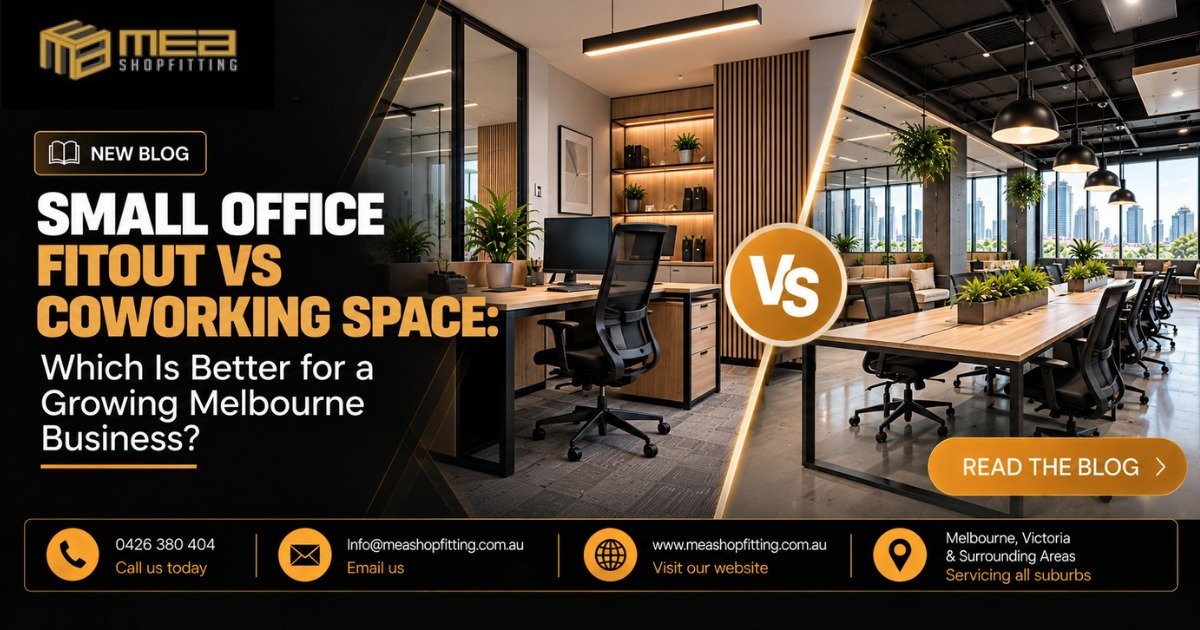
Sooner or later, a growing business hits the same wall. The kitchen table, the spare room or the borrowed desk stops working. You’ve got staff, clients, equipment and a brand to look after, and you need a proper place to do it.
Two options come up straight away. You can lease your own Small Office Fitout vs Coworking Space out the way you want it, or you can join a coworking space and pay a monthly fee for a desk or a private room. Both can work well. Both can also be an expensive mistake for the wrong business at the wrong time.
At MEA Shopfitting we build commercial fitouts across Melbourne, Victoria and the surrounding areas, so we hear this question a lot. We’ll be honest about it, because coworking is a good fit for plenty of businesses, and a small office fitout is a better fit for plenty of others. Here’s how to tell which one is yours For Small Office Fitout vs Coworking Space.
The short answer
If you need flexibility, a short commitment and very little upfront spending, coworking is hard to beat. If you need your own space, your own brand, room to grow and a base you can shape around how your team works, a small office fitout usually wins over the long run.
Most businesses sit somewhere between those two descriptions, which is why it’s worth looking at the details.
What each option actually is
Coworking space. You rent a desk, a private room or a membership inside a shared building run by an operator. Furniture, internet, meeting rooms, cleaning and a kitchen are usually included. You’re typically on a flexible or short-term agreement, and you share the building with other businesses.
Small office fitout. You lease your own tenancy, then fit it out to suit you, with partitions, flooring, lighting, joinery, storage, power and data planned around your team. You pay for the build upfront, but you control the space and the brand experience.
There’s also a middle ground, such as a serviced office, which is a private, furnished office with a longer agreement. It’s closer to coworking in how it’s run, but with a door that shuts.
1. Cost: look at the whole picture
Cost is usually the first question, and it’s also the easiest one to get wrong, because the two options charge you in very different ways.
Coworking is mostly a monthly fee with little upfront. Published figures vary by source and by location, but one marketplace’s data put the average Melbourne coworking desk at around A$493 per month, while another directory reported a median of about A$434 for a monthly coworking desk and about A$519 for a private desk. A separate pricing guide put similar private setups in Melbourne at roughly $700 to $800 per desk per month. The numbers differ because the buildings, locations and inclusions differ, so treat them as a rough range, not a quote. Coworking Space Cost in Australia: A Comprehensive Guide (2026) +2
A small office is the other way around. You pay rent and outgoings, plus the fitout, plus furniture, IT and signage. The fitout is a one-off cost that can be significant, but you’re not paying a premium for shared services every month, and you’re building something that belongs to your business.
Here’s a simple way to think about it:
- For a short horizon (under a year or two, or an uncertain headcount), coworking often costs less overall, because you’re not spending on a build you’ll walk away from.
- For a longer horizon (three to five years or more, with a stable or growing team), the maths often shifts toward your own office, because the fitout cost is spread across the lease.
- Per-desk pricing grows with your team. If you’re going from 3 desks to 10, coworking costs scale up in direct proportion. A small office with room for 10 doesn’t.
The right way to compare is to add up the total cost over the period you expect to stay, not just the monthly figure.
2. Flexibility and commitment
This is where coworking shines. Most agreements are short or rolling, and you can add or drop desks as your team changes. If you’re not sure how big you’ll be in six months, that’s worth a lot.
A leased small office is a bigger commitment. Commercial leases usually run for a few years, and there may be clauses about the condition you return the space in. You’ll also need landlord approval for your fitout plans. On the other hand, a longer lease gives you stability, and landlords will sometimes offer incentives for longer terms.
If your business is still testing its model, coworking buys you time. If you’re past that stage, a lease is a sign you’re settled.
3. Brand and first impressions
When a client walks into your space, they judge your business in seconds. In a coworking space, they arrive in someone else’s reception, someone else’s lobby and someone else’s design. Your business lives in a room or at a desk, and your brand is a guest.
In your own fitout, you control the whole experience: the entry, the reception, the colours, the lighting, the meeting room and the way the place feels. A small office with good joinery, warm lighting and a tidy layout says something about how you run your business before you’ve said a word.
That matters most for businesses that host clients often, such as accountants, lawyers, architects, consultants, health and wellbeing practices and trades with showroom-style offices. If clients rarely visit, it matters less.
4. Privacy, security and noise
Shared buildings are social, and that’s part of the appeal. They can also be noisy, and you can’t control who’s at the next desk.
If your team handles confidential client information, takes lots of calls or needs focus time, privacy is a real factor. Many coworking spaces offer private offices and phone booths, which helps, but you’re still working within the operator’s rules and layout.
In your own office, you decide where the walls go, how much acoustic treatment is built in, who has keys and how your files, data and equipment are secured. For a business dealing with sensitive information, that control is worth a lot.
5. Room to grow, and room to adjust
Coworking operators let you scale up by taking more desks or a bigger room, as long as space is available. That’s convenient, but it depends on the building, and it can get expensive quickly.
With your own tenancy, you grow into the space you’ve built. A well-planned small office can accommodate extra desks, a meeting room or a storage wall as you go. Custom joinery can be designed to flex, with workstations that can be rearranged and storage that can be extended.
The flip side is that if you outgrow your office, you’ll need to move and fit out again. That’s why it’s worth planning for two to three years of headcount when you design it, not just today’s.
6. Productivity and company culture
Some people thrive in the buzz of a coworking space. Networking events, nearby start-ups and a lively atmosphere can be energising, especially for freelancers and very small teams.
As a team grows, though, many businesses find they want a space that reflects how they work. That might mean a team zone with proper desks, a quiet room for calls, a kitchen where staff can gather and storage that stops clutter building up. A fitout designed around your workflow is easier to make productive than a generic layout built for everyone.
It’s also easier to build culture in a space that’s yours. Photos on the wall, a team area that’s set up the way you like and a meeting room you don’t have to book through an app all help.
7. What a small office fitout actually involves
If you’re leaning toward your own space, here’s what the process usually looks like, so you can judge whether it’s something you want to take on:
- Find the premises and check the lease terms, permitted use and landlord requirements.
- Plan the layout around how many people you have now and expect in two or three years.
- Design the space, including joinery, lighting, storage, power and data.
- Check approvals. Commercial fitouts in Victoria may need a building permit, and a registered building surveyor can confirm what applies. You’ll also need landlord approval.
- Order materials. Custom joinery and glazing can take weeks, so lead times matter.
- Build. Services, partitions, ceilings, flooring, joinery and finishes go in.
- Inspect and hand over. Final checks, certificates and a defects list.
- Move in.
Planning and approvals often take as long as construction itself, so start well before your target move-in date. A good contractor will walk you through each step, and make sure you know what’s coming.
8. What affects the cost of a small office fitout?
We can’t give an honest number without seeing the space, because costs vary widely. The main factors are:
- The condition of the premises. A tenancy with good ceilings, lighting and air-conditioning costs far less to fit out than a bare shell.
- How much you’re changing. A light refresh costs less than new partitions, glazing and services.
- Joinery. Custom reception counters, kitchens and storage are an investment, and often what gives an office its character.
- Services. Electrical, data and air-conditioning changes can add up, especially in older buildings.
- Finishes. Flooring, laminates and lighting all affect the price.
- Furniture and extras. Desks, chairs, signage, IT and moving costs are often priced separately.
- Timing. Rushing costs more.
When you compare quotes, check that each one covers the same scope. A low price that leaves out joinery, services or approvals isn’t really low.
9. When coworking is the better choice
Coworking tends to suit you if:
- You’re a start-up, freelancer or very small team testing the market
- Your headcount is unpredictable
- You need to be operating within days, not months
- You’d rather not spend capital on a build
- Clients rarely visit, and a meeting room by the hour is enough
- You want community and networking built in
- You only need a presence in a particular suburb for a short period
10. When a small office fitout is the better choice
Your own fitout tends to suit you if:
- You have a stable or steadily growing team
- You plan to stay put for several years
- Clients visit regularly and your brand matters
- You handle confidential information or take a lot of calls
- You have specific equipment, storage or layout needs
- You want to build a culture in a space that feels like yours
- You’d like predictable costs over a longer term
11. The middle path
You don’t always have to pick one for good. Plenty of Melbourne businesses use a mix:
- Start in coworking, then move into a fitout once the team and revenue are steady. This is a common path for growing businesses, and it lets you design your office around what you’ve learned.
- Run a small office plus a coworking membership for staff who work remotely or need a presence in another area.
- Choose a lightly fitted office to keep the upfront cost down, with simple layouts, a few strong joinery pieces and room to add more later.
- Take a serviced office as a stepping stone, with a private door and furniture, but less commitment than a long lease.
If you do plan to move into your own space eventually, talk to a fitout contractor early. They can tell you what to look for in premises and what it would cost, long before you need to decide.
What about regional Victoria?
Coworking is most common in the Melbourne CBD and inner suburbs. Options in regional centres and outer growth areas vary by town, and there may be fewer choices, so check what’s actually available near you before you plan around it. For many businesses in places like Geelong, Ballarat, Bendigo, Melton, Officer, Somerville, Seymour and Moe, having your own small office, shopfront or professional suite is the more practical path, and local rents can leave more room in the budget for a good fitout.
MEA Shopfitting works across Melbourne and the wider region, and we visit the space in person wherever it is.
A quick checklist to help you decide
Ask yourself:
- How many people will be in the office now, and in two or three years?
- How often do clients visit?
- Do we handle confidential information or make lots of calls?
- How long do we expect to stay in one place?
- How much can we spend upfront, and how much per month?
- Do we need our own brand environment, or is a good meeting room enough?
- What does a lease commit us to, and what does it cost to leave?
- Are there coworking options near where our team lives and works?
If most of your answers point to short term, uncertain and low-visibility, coworking is likely the right move. If they point to stable, growing and client-facing, look seriously at your own fitout.
Frequently Asked Questions Small Office Fitout vs Coworking Space
Is a small office fitout cheaper than coworking in Melbourne?
It depends on how long you stay and how many people you have. Coworking costs less upfront because there’s no build, but the monthly fee is charged per desk and keeps going. A small office costs more at the start because of the fitout, but over several years, and with a growing team, it can work out better value. The most reliable way to compare is to add up the total cost over the period you expect to stay.
How long does a small office fitout take?
Many small fitouts take a few weeks on site, but design, approvals and material lead times usually come first and can take as long as the construction. Custom joinery and glazing often have the longest lead times, so start early, ideally before you sign the lease or well before your move-in date.
Do I need a building permit to fit out a small office in Victoria?
Not always, but you shouldn’t assume you don’t. Work that affects partitions, exits, fire safety, accessibility or building services often needs approval, even when it isn’t structural. A registered building surveyor can confirm what applies to your premises, and your landlord will usually need to approve the plans as well.
Can I start in coworking and move to my own office later?
Yes, and many businesses do. It lets you test the market and build your team without a big upfront commitment, then fit out your own space once your needs are clearer. If you plan to make that move, speak to a fitout contractor a few months ahead so design, approvals and construction are ready when your coworking agreement ends.
Do you do small office fitouts outside Melbourne, like Geelong, Ballarat or Bendigo?
Yes. MEA Shopfitting services Melbourne, Victoria and surrounding areas, including Geelong, Ballarat, Bendigo, Melton, Officer, Somerville, Seymour and Moe, as well as other suburbs and towns. Contact us with your location and a few details about your space.
Ready to build a space that fits your business?
If you’re weighing up coworking against your own office, talk to us. Tell us about your team, your budget and how you work, and we’ll give you an honest view of what a small office fitout would involve.
Contact MEA Shopfitting
📞 Call us today: 0426 380 404
✉️ Email: Info@meashopfitting.com.au
🌐 Website: www.meashopfitting.com.au
📍 Melbourne, Victoria & Surrounding Areas, servicing all suburbs