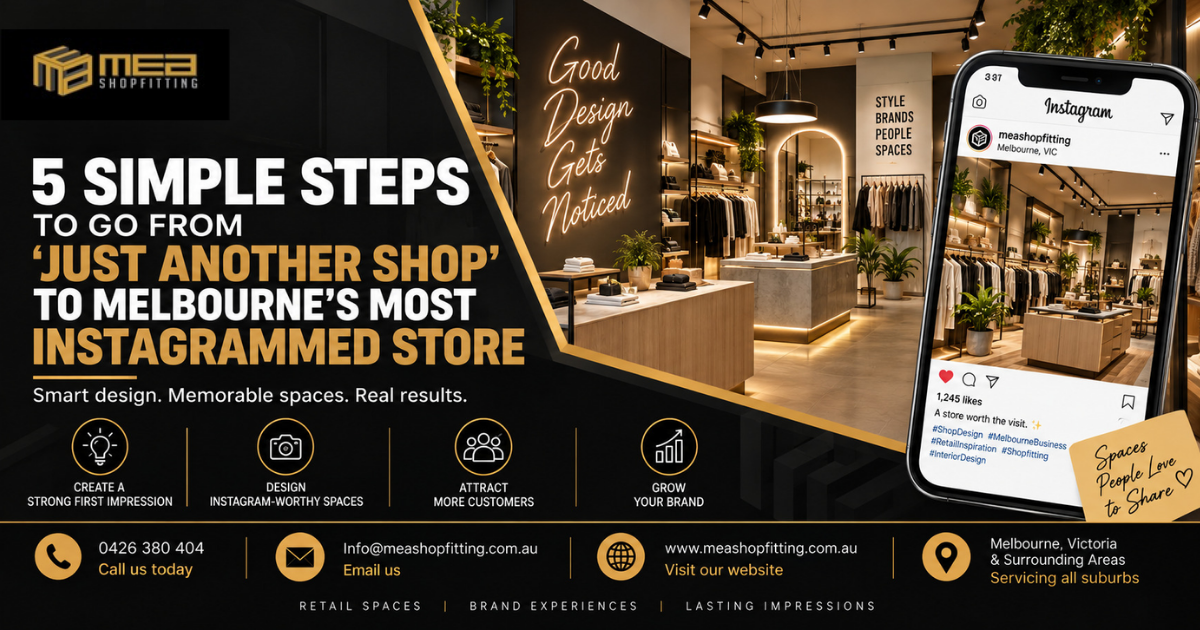
Walk down any strip in Chapel Street, Bridge Mall in Ballarat, or the Bendigo CBD and you’ll notice something quickly: some shops stop people mid-stride, and most don’t. The difference is rarely the products on the shelf. It’s almost always the shopfitting — the layout, the lighting, the little design choices that make a space feel like somewhere worth stepping into (and worth pulling your phone out for).
At MEA Shopfitting, we work with retailers across Melbourne and regional Victoria who are tired of blending in. Whether you’re opening your first boutique in Officer, refreshing a tired fit-out in Geelong, or planning a full retail refit in Moe, the goal is the same: a store that gets noticed, gets photographed, and gets remembered. Below, we’ve broken down the five steps we walk our clients through to turn “just another shop” into the kind of space customers can’t help but share.
Why Store Design Matters More Than You Think
Good design isn’t decoration — it’s a business decision. Retailers who invest properly in their fit-out see customers spend longer in-store, browse more of the range, and walk away with a stronger impression of the brand than they would in a flat, generic space. On social media, the effect compounds: industry research suggests thoughtful retail design can lift sales by as much as 40%, with customers spending nearly a third more time in stores that feel visually appealing and easy to move through. And with a large majority of Instagram users saying they use the platform to discover new products or brands, a store designed with even one “photo moment” built in is doing marketing for you long after the customer has left.
That’s the philosophy behind MEA Shopfitting’s approach: smart design, memorable spaces, real results.
Step 1: Create a Strong First Impression
You have a matter of seconds to convince someone on the footpath that your shop is worth entering. That first impression is built from the outside in — your shopfront signage, window display, entry lighting, and the sightline a passer-by gets the moment they glance through the glass.
We see this play out differently depending on location. A boutique in a busy Melbourne CBD laneway competes with dozens of other storefronts in a single block, so bold signage and a striking window display do the heavy lifting. A retailer in a growing town centre like Melton or Seymour, where foot traffic is steadier but competition is thinner, often gets more value from a shopfront that signals quality and permanence — the kind of design that says “this business is here to stay.”
Either way, the first impression isn’t just about looking nice. It sets an expectation for what’s inside, and it’s the first thing a customer will photograph if you get it right.
Step 2: Design Instagram-Worthy Spaces
This is where most retail fit-outs fall short — not because the budget wasn’t there, but because “Instagrammable” was treated as an afterthought rather than something designed in from the start.
A genuinely shareable space usually has a few things in common:
- A feature wall or lighting moment — a neon sign, a statement light fixture, or a textured backdrop that gives customers a natural spot to stop and take a photo.
- Considered materials and finishes — warm timber, brushed metal, layered lighting and greenery read far better on camera than flat white walls under harsh fluorescents.
- A logical flow — customers should move naturally from the entry through to feature displays and finally to the counter, with each zone offering something visually different.
- Product staging that photographs well — the way stock is merchandised (grouped, spaced, lit) matters just as much as the shelving itself.
We design these elements into the fit-out itself — the joinery, the lighting plan, the finishes — rather than bolting them on afterwards. That’s the difference between a store that occasionally gets tagged on Instagram and one that customers actively seek out to photograph. And it matters commercially: a large share of Instagram users engage with shopping features when they’re already browsing, and many say they’ve discovered a brand or product on the platform that they now use regularly. A store that photographs well simply gets seen by more people, more often.
Step 3: Attract More Customers
A beautiful store that no one walks past is still an empty store. This step is about making sure the design actually converts visibility into foot traffic — and then converts foot traffic into sales.
Layout plays a bigger role here than most retailers expect. Where you place your entry display, how wide your aisles are, where the till sits, and how easily a customer can browse without feeling crowded or lost — all of it affects whether someone stays for two minutes or twenty. We also factor in practical realities specific to each suburb: a store in Somerville or Officer, in the middle of Melbourne’s fast-growing outer growth corridors, is often serving a younger, family-heavy customer base that values easy pram access and clear sightlines to kids’ areas. A boutique in inner Melbourne might prioritise a more intimate, curated layout instead.
Good shopfitting also supports your staff to sell. Well-placed counters, accessible stock rooms, and displays that are easy to restock all mean your team spends less time managing the space and more time engaging with customers.
Step 4: Grow Your Brand
Your fit-out is one of the most powerful (and most under-used) branding tools you have. Colour palette, signage typography, material choices and even the scent and sound of a space all reinforce — or undercut — the brand story you’re telling everywhere else, from your packaging to your social media.
For retailers with multiple locations, or plans to expand into new suburbs like Bendigo, Ballarat or Geelong, consistency matters. A recognisable design language across stores builds trust faster with new customers who may already know your brand from Instagram before they’ve ever walked through your door. This is increasingly how retail actually works: the modern retail Instagram feed’s job isn’t to ring up the sale directly — it’s to build enough trust that a customer follows the link to your website or walks into your store. Your physical shopfit is what has to deliver on that promise the moment they arrive.
Step 5: Deliver Real Results
None of the above matters if it doesn’t translate into business outcomes — more customers through the door, longer dwell times, higher average spend, and a store that keeps generating word-of-mouth (and social) marketing long after opening day. This is why we treat every project as a partnership rather than a one-off job: we want to understand your customer, your product, and your growth plans before a single wall goes up.
From concept and design through to construction and final fit-out, Contact MEA Shopfitting for manages the full process for retail spaces and brand experiences across Melbourne and Victoria — so you get a store that looks the part and performs.
Shopfitting Across Melbourne and Regional Victoria For Melbourne’s Most Instagrammed Store
One of the things we hear most often from retailers outside the CBD is that it’s hard to find a shopfitter who understands regional and growth-corridor retail, not just inner-city boutiques. We work across:
- Melbourne CBD and inner suburbs
- Bendigo — a growing regional retail hub with its own strong local identity
- Ballarat — heritage streetscapes that call for a fit-out that respects the building while still standing out
- Geelong — Victoria’s second city, with a retail scene that’s grown fast in recent years
- Melton and Officer — fast-growing outer suburbs where new retail precincts are opening regularly
- Somerville — Mornington Peninsula’s growth corridor, popular with young families
- Moe and the Latrobe Valley
- Seymour and surrounding regional towns
Wherever your store is, the fundamentals are the same: a strong first impression, a design that photographs well, a layout that attracts and moves customers, a fit-out that grows your brand, and a project delivered properly from start to finish.
Frequently Asked Questions About Melbourne’s Most Instagrammed Store
1. How much does a retail shopfit typically cost in Melbourne? It varies widely depending on the size of the space, the level of custom joinery, lighting design, and finishes involved. A small boutique refresh will cost significantly less than a full retail fit-out with custom cabinetry and feature lighting. The best approach is to get a proper consultation and quote based on your space and goals — we’re happy to talk through options and budgets before you commit to anything.
2. Do you only work in Melbourne, or do you service regional Victoria too? We service Melbourne and surrounding suburbs as well as regional areas including Bendigo, Ballarat, Geelong, Moe, Seymour, Somerville, Melton and Officer. If you’re planning a retail fit-out anywhere in Victoria, get in touch and we can talk through logistics.
3. How long does a typical shopfitting project take? Timelines depend on the scope — a straightforward refresh might take a couple of weeks, while a full retail build-out with custom joinery, electrical work and feature lighting can take several weeks to a few months. We map out a realistic timeline with you at the start so there are no surprises, and we work to minimise disruption to trading wherever possible.
4. Can you help redesign an existing store, or do you only do new fit-outs? Both. Plenty of our work is refreshing existing stores that have started to feel dated or aren’t performing the way they should — new signage, a feature wall, updated lighting or a reworked layout can make a significant difference without a full rebuild. We also handle complete fit-outs for new leases and first-time store openings.
5. Will a better-designed store actually help with things like Instagram and social media, or is that just a nice bonus? It genuinely helps. Customers photograph and tag stores that give them a reason to — a striking feature wall, good lighting, an interesting layout. Instagram-worthy elements are the kind of thing that don’t need a marketing budget to work; they get shared organically because customers want to show off where they’ve been. When we design a fit-out, we build in a “photo moment” from the start rather than treating it as decoration.
Ready to Stand Out?
If your store is blending into the background instead of stopping people in their tracks, it’s worth having a conversation. MEA Shopfitting works with retailers across Melbourne, Bendigo, Ballarat, Geelong, Melton, Officer, Somerville, Moe, Seymour and surrounding suburbs to design retail spaces people genuinely love to share.
Get in touch:
- 📞 Call us today: 0426 380 404
- ✉️ Email: info@meashopfitting.com.au
- 🌐 Website: www.meashopfitting.com.au
- 📍 Servicing Melbourne, Victoria and surrounding suburbs