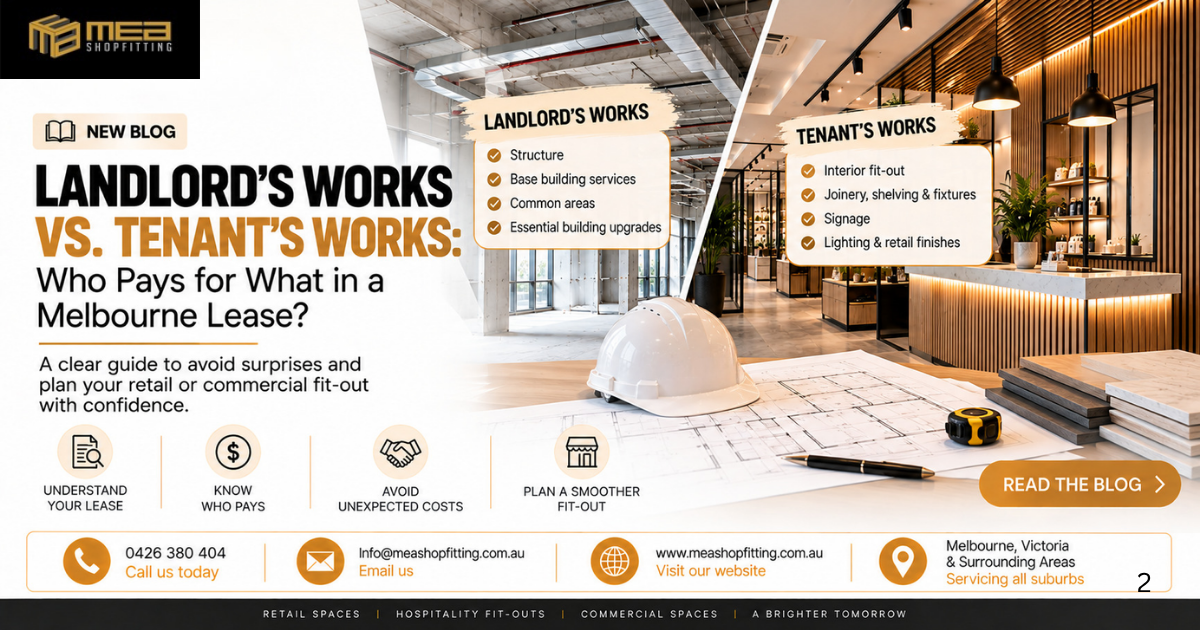
A clear guide to avoid surprises and plan your fit-out with confidence.
Of all the questions we get asked by new tenants, this is one of the most consistently misunderstood: exactly who is responsible for what, once you’ve signed a commercial lease. It sounds like it should be simple, but Australian commercial leasing doesn’t work off a single standard split it comes down entirely to how your specific lease is worded. Getting clarity on this before you sign can save you thousands of dollars and a genuinely frustrating dispute down the track Landlord’s Works vs. Tenant’s Works. Here’s how to think it through properly .
Understand Your Lease: There’s No Universal Standard
Unlike residential tenancies, which are governed by fairly prescriptive legislation, commercial leases are largely shaped by whatever the lease document itself says. There’s no automatic, universal rule that says a landlord always handles the roof and a tenant always handles the fit-out — those splits are common, but they’re contractual, not guaranteed. This is exactly why reading your lease carefully — or better, having it reviewed by someone experienced in commercial leasing before you sign — matters so much. Assuming a responsibility sits with the landlord because “that’s how it usually works” is one of the most common and costly mistakes new tenants make.
Landlord’s Works: What Typically Falls to the Building Owner
While every lease is different, there’s a general pattern that most commercial leases in Melbourne follow when it comes to landlord responsibilities:
Structure — foundations, load-bearing walls, the building’s roof and structural integrity are commonly retained as landlord responsibilities, since these affect the building as a whole, not just your individual tenancy.
Base building services — the core infrastructure that serves the building, such as the main electrical switchboard, primary plumbing, and structural fire safety systems, generally sits with the landlord, though what counts as “base building” versus “tenant” infrastructure can vary depending on where the line is drawn in your specific lease.
Common areas — shared spaces like lobbies, shared corridors, car parks and amenities used by multiple tenants are typically the landlord’s responsibility to maintain, as part of the broader building rather than any single tenancy.
Essential building upgrades — larger capital works, such as major system replacements or upgrades required to meet updated safety standards, are often — though not always — kept as a landlord responsibility. This is a genuine grey area worth checking specifically, since some leases push even significant upgrade costs back onto tenants depending on how the clause is worded.
Tenant’s Works: What Generally Falls to You
On the other side of the ledger, a fairly consistent set of responsibilities tends to sit with the tenant across most commercial leases:
Interior fit-out — everything inside your leased space that makes it functional for your specific business, from partitions and flooring through to internal finishes, is almost always a tenant responsibility, built to your own design and budget.
Joinery, shelving and fixtures — custom counters, shelving, display units and other fixtures specific to your business and how it operates are standard tenant-funded elements of a fit-out.
Signage — your shopfront signage, window displays and any branded elements are typically your responsibility to design, fund and install, generally subject to landlord and council approval.
Lighting and retail finishes — beyond the building’s base electrical infrastructure, the specific lighting design, fixtures and retail finishes that reflect your brand and support your operation are standard tenant works.
Why the Line Isn’t Always as Clean as It Looks
Here’s where things genuinely get complicated: many leases don’t use a simple landlord-versus-tenant split at all. Instead, obligations are often framed around distinctions like repair versus replacement, or routine maintenance versus capital works — and where a specific issue falls within those categories can be genuinely ambiguous. A failed hot water unit, for example, might be treated very differently depending on whether your lease frames it as a repair (potentially a tenant cost) or a replacement of ageing infrastructure (potentially a landlord cost, if the lease is worded that way). This is exactly the kind of detail worth clarifying before you sign, not discovering when something breaks.
Avoid Unexpected Costs by Asking the Right Questions Upfront
Before committing to a lease, it’s worth getting clear, direct answers to a handful of practical questions: Who repairs the roof if it leaks? Who’s responsible if the main electrical board or air conditioning system fails? What condition is the space being handed over in, and is that documented? What’s included in any fit-out contribution or incentive being offered, and what falls outside it? These aren’t awkward questions to ask a landlord or leasing agent — they’re standard due diligence, and a landlord who’s reluctant to answer them clearly is itself worth noting.
Plan a Smoother Fit-Out by Getting This Sorted Early
Understanding exactly where the landlord’s responsibility ends and yours begins isn’t just a legal formality — it directly shapes your fit-out budget and timeline. If you assume something is included and it isn’t, that gap needs to be absorbed into your construction budget, often discovered partway through the project rather than at the planning stage where it’s far easier to manage. Getting absolute clarity on this split before finalising your fit-out design and budget is one of the simplest ways to avoid a stressful, expensive surprise mid-construction.
Working With a Shopfitter Who Understands This Split
An experienced shopfitter who regularly works across Melbourne commercial leases will already understand the common patterns in how landlord and tenant works are typically divided, and can help you interrogate your specific lease before construction begins — flagging anything unclear or unusual so it can be clarified with your landlord early, rather than becoming a dispute once work is already underway.
Helping Tenants Understand Their Lease Across Melbourne and Regional Victoria
We help business owners understand exactly what they’re responsible for before their fit-out begins, across Melbourne and the surrounding suburbs, as well as regional Victoria including Bendigo, Ballarat, Geelong, Melton, Somerville, Moe, Officer and Seymour.
Frequently Asked Questions About Landlord’s Works vs. Tenant’s Works
1. Is there a standard rule for what landlords versus tenants pay for in Australia?
Not a universal one — commercial leases are governed primarily by the lease document itself, and while common patterns exist (structure and base building generally landlord, interior fit-out generally tenant), this isn’t guaranteed and varies by lease.2. Who pays if the air conditioning or electrical system fails during my tenancy?
It depends on your specific lease and how it distinguishes between repair, replacement and capital works — this is a common grey area worth clarifying directly with your landlord or lease advisor before signing.3. Does the landlord ever contribute to my interior fit-out?
Sometimes, through a fit-out contribution or incentive negotiated as part of your lease — but this isn’t automatic and needs to be specifically negotiated and documented, not assumed.4. What happens if my lease doesn’t clearly specify who’s responsible for something?
This is exactly where disputes tend to arise. If a lease is silent or ambiguous on a specific responsibility, it’s worth seeking clarification or legal advice before signing, rather than after an issue arises.5. Should I get my lease reviewed before signing, or is this something a shopfitter can help with?
Both have a role — a lawyer experienced in commercial leasing can properly interpret the legal obligations, while an experienced shopfitter can help you understand the practical fit-out implications of those terms and flag anything unusual.
Planning a Fit-Out and Want Clarity on Your Lease Obligations First?
Talk to MEA Shopfitting before you finalise your fit-out budget and design.
📞 0426 380 404
📧 info@meashopfitting.com.au
🌐 www.meashopfitting.com.au